
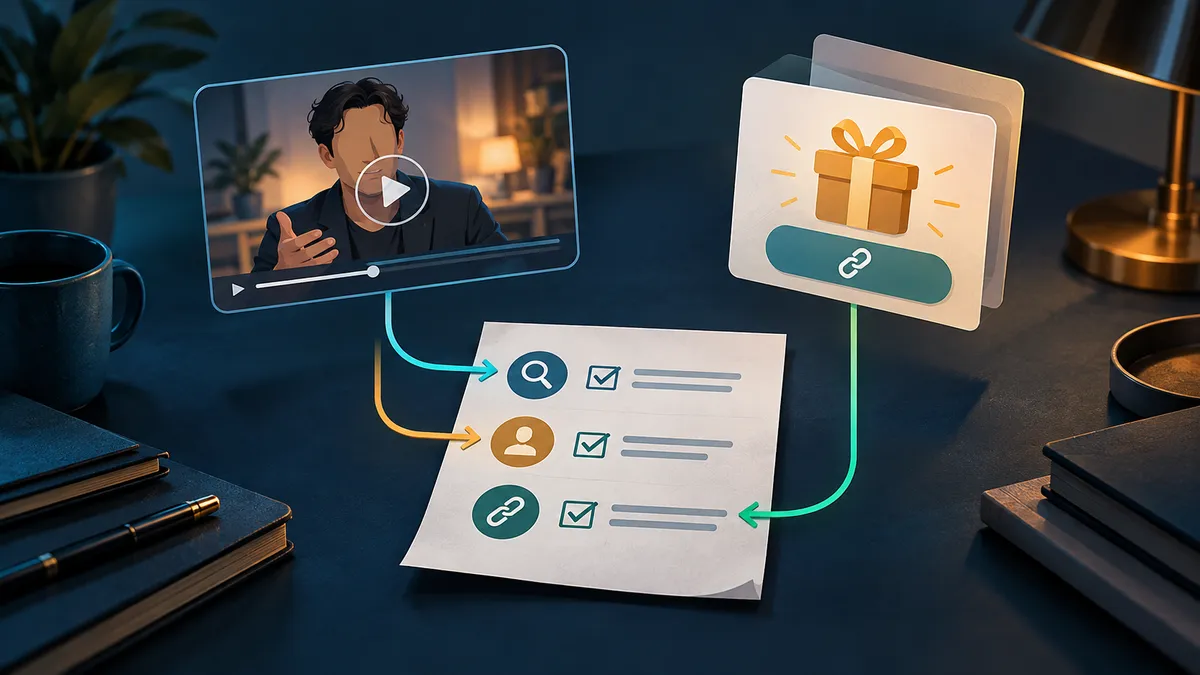
When a celebrity video promotes a giveaway, product or investment, check three things separately: the clip, the claimed endorsement and the action you are being asked to take. Pause before following the promoted link or sharing personal information. Find the person's established channels independently, look for the exact promotion and compare the full context. A realistic face, familiar voice or low detector score cannot confirm an offer. An AI video detector can supply preliminary media signals, but it cannot verify identity, authorize a payment or establish that a claim is true. Leave unresolved endorsements unverified rather than forcing a real-or-fake verdict.
Separate the face from the offer
A video can be authentic while its caption is misleading. An old interview can be presented beside an unrelated sales message. A synthetic clip can also imitate someone who never made the statement. These possibilities require different evidence, so begin with the claim you actually need to check.
Write it down without adding an interpretation: “This account says this person is promoting this offer today.” Then identify the next requested action. Is it to visit a site, send a message, provide account information or pay a charge? You can decline that action while the media remains unresolved. You do not need to identify the editing technique before protecting your own decision.
This guide is an editorial verification method from primary consumer-protection sources checked on October 31, 2026. It is not an investigation of a named person, an independent detector benchmark or advice to enter a financial transaction. AI Video Detector is one optional screening aid in the workflow; our team publishes this guide and operates that service.
Use a three-question worksheet
| Question | Useful evidence | What that evidence cannot establish |
|---|---|---|
| Where did this exact clip come from? | Earlier publication, fuller footage and an identifiable source | That the current sales message belongs to the original |
| Did the person make this particular endorsement? | A matching announcement reached independently through an established channel | That every account repeating it is authorized |
| What does the offer ask me to do? | Exact wording, destination and independently confirmed organization | That a familiar face makes the destination trustworthy |
Keep separate notes for each row. “Earlier footage found” is a useful observation, but it is not the same as “promotion confirmed.” Likewise, “no obvious manipulation detected” says little about the seller, the destination or the terms shown elsewhere.
For the broader media-evidence process, use our suspected-deepfake verification checklist. This article adds the endorsement and requested-action checks that a general media review cannot settle on its own.
First preserve a small, useful record
Save the public post URL, account name, visible publication date and the wording of the offer. A screenshot can help record what you saw if the caption later changes. Note when you captured it and distinguish the post's date from your own observation date.
Keep this record private while checking. Avoid reposting the clip to recruit strangers into an investigation, and do not collect unrelated personal details about an uploader. You are trying to assess a message, not establish the identity or intent of every person who shared it.
If the material is private, sensitive or includes someone else's personal information, do not upload it to a public tool merely to obtain a score. Use the platform's appropriate support process and seek qualified help for consequential concerns. Our abuse policy explains the boundaries around targeting people and using screening reports.
Find the claimed announcement independently
Start from a source you reach separately from the advertisement. Search for the person's established website or known public channel, then look for the exact product, giveaway or announcement. Compare the offer name, organization and timing, not just whether the celebrity has ever mentioned a similar topic.
An account name copied from the clip, a familiar profile photo or a link supplied by the seller is not independent corroboration. Several pages may repeat the same material. Ask whether each page has evidence of its own or is simply sending you back to the original promotion.
The Better Business Bureau's celebrity-impersonation guidance describes consumer reports involving apparent celebrity endorsements and counterfeit promotional destinations. It supports checking the promotion beyond its presentation. It does not mean every celebrity advertisement is fraudulent or that an unfamiliar account proves impersonation.
If you cannot find independent confirmation, record “not confirmed through an independent source.” Absence from your search is not proof of fabrication, but it is a reason to keep the proposed action on hold.
Compare the footage with its earlier context
Look for a longer or earlier version of the clip. A distinctive phrase, an event name visible in the background or a representative frame may help locate the source. Our reverse video search workflow explains how to compare earlier appearances while preserving uncertainty about what you found.
When you find a possible match, check whether it actually contains the advertised endorsement. The same jacket, stage and camera angle can help identify reused footage, but they do not establish what was said throughout a longer recording. Compare the spoken passage, caption and sequence around it.
Watch for a mismatch between the original subject and the present offer. A genuine discussion of a charitable event does not automatically support a new donation destination. A real product interview does not authorize every later checkout page. Record the specific mismatch rather than announcing that the whole video is fake.
You may be unable to locate the original. Short clips, cropping and repeated reposts can limit source tracing. Keep the source question open and move to independent confirmation of the offer instead of treating a failed search as a detector result.
Review the requested action before the pixels
Copy the destination as text if it is already visible; do not visit an unfamiliar page simply to complete a checklist. Check what the offer asks you to surrender: money, credentials, a verification code, personal details or ongoing contact. Separate those requests from the familiar face used to introduce them.
The CFTC's explanation of imposter fraud describes how impersonators build credibility and use emotional pressure or urgency to obtain engagement. Treat that as a reason to slow the decision and use an independent route to the relevant organization. This article does not evaluate investments or establish that a particular seller is legitimate.
Write down any condition that discourages checking elsewhere, such as an instruction to act immediately or keep the conversation secret. Those are observations about the message. They do not require a technical claim about how the video was made.
If someone you know has already acted, prioritize contact with the relevant payment provider, account provider or official reporting service through independently located contact details. A video analysis should not delay that contact, and no detector result can promise recovery.
Use automated screening for a bounded question
A public-video check may help you organize possible manipulation signals and limitations for the particular media available. Before using one, ask what was actually examined: the video content, available metadata, a limited passage or only material accessible through the link. A completed report and a failed or limited check are different outcomes.
Read the evidence report explanation before interpreting a score. Screening cannot establish the person's identity, confirm an endorsement, determine criminal intent or verify the offer's factual claims. A high signal is not grounds for a public accusation; a low signal is not permission to proceed.
The FBI's December 3, 2024 public warning explains that generated videos can support impersonation and misleading promotions. The relevant lesson is to confirm the situation through another channel. It is not evidence that a particular clip was generated, nor a benchmark for our service.
Avoid sending the same clip through many services until one gives the answer you hoped for. Different tools may inspect different material or express uncertainty differently. Keep the original question and record the limitations instead of averaging incompatible scores.
A hypothetical review, with no invented result
Suppose a public post shows a recognizable actor beside a caption offering a limited giveaway. You find an earlier interview with similar footage, but the interview does not mention that giveaway. The only promotion pages you locate repeat the same caption and destination.
Your worksheet could say: “Possible earlier footage located; exact endorsement not found; destination supported only by the promotion itself.” That is enough to leave the offer unverified. It does not identify who edited the video or prove that a crime occurred.
If a screening report is also available, add its observation as a separate line with its date and limitations. Do not replace the worksheet with a single percentage. The next useful step is independent confirmation, not a stronger accusation about the actor or uploader.
This example is a constructed decision exercise. It describes no actual celebrity, victim, detector output, payment or successful investigation.
Help someone check without turning it into an argument
If a relative sends you the clip, begin with the action rather than a debate about their ability to spot AI. Ask to pause the promotion while you locate the same announcement independently. Compare the exact offer together and show which part is confirmed and which remains unknown.
A short note is often more useful than a long technical explanation: “We found the interview, but not this promotion on a separately located channel.” Preserve their privacy and avoid posting their messages or payment details publicly. The goal is a safer decision with a clear evidence trail, not winning an argument about visual realism.
Frequently asked questions
Does a realistic celebrity video prove the endorsement is genuine?
No. Real footage can be reused in a different context, and generated media can look convincing. Confirm the exact promotion through an independently reached source. Keep the footage question and the offer question separate.
Is a low AI-detection score enough to trust the offer?
No. Screening does not verify the seller, destination, identity or transaction. Read what was examined and what was unavailable. A report may add media observations while leaving the endorsement and offer unverified.
Should I publicly label the uploader a scammer?
Do not make a public accusation from a clip or automated result. Preserve the relevant public details and use appropriate platform or official reporting channels. Consequential claims need qualified human review.
What if the original video is real but the caption is different?
Record that difference precisely. Earlier authentic footage does not establish that the later caption or promotion was authorized. Seek confirmation of the exact offer, including its timing and destination, through another channel.
Should I wait for a detector before contacting a payment provider?
No. If you have already shared payment or account information and are concerned, contact the relevant provider through a known official route. Media screening should not delay that contact and cannot promise reimbursement or recovery.
Next step and review boundary
Use the worksheet before considering an optional public video screening check. Keep the result preliminary and return to source and offer confirmation afterward. No score provides an identity decision, accusation, endorsement verification or factual verdict.
Sources were checked October 31, 2026. This guide provides a reproducible editorial method, not hands-on testing of a specific advertisement or proof that every current platform link can be analyzed.