
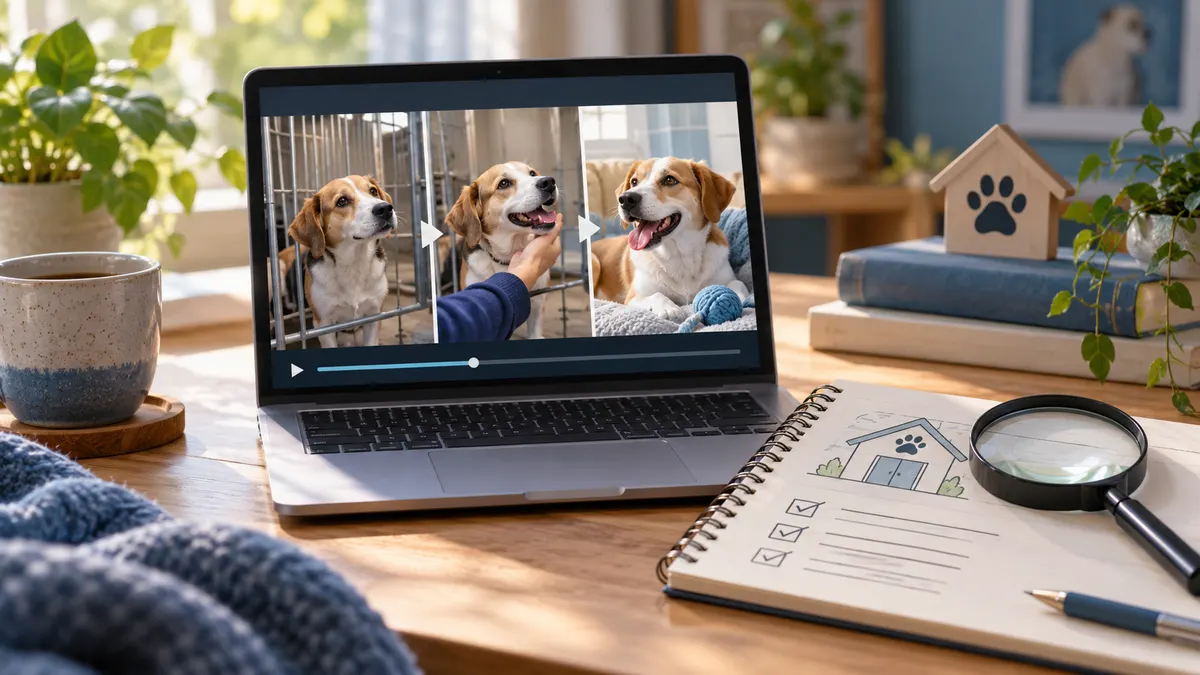
Some animal rescue videos may be synthetic, while others use real footage with a misleading story. You cannot reliably decide which from a dramatic moment, an unusual paw, or a detector score alone. Before sharing, separate three questions: where the footage came from, whether the named rescuer supports the story, and whether any attached appeal actually belongs to that organization. Look for a fuller source and independently confirmed follow-up, preserve uncertainty, and avoid public accusations. An AI video check can help organize further inspection; it cannot authenticate a rescue, certify an organization, or verify a fundraising claim.
Start with the story you are being asked to endorse
A short rescue clip often arrives with several claims bundled together: this happened recently, this person helped this animal, the animal now needs something, and the account sharing it represents the rescuer. Even if the footage is genuine, those other claims still need support. Conversely, an openly labeled fictional animal animation does not automatically make its creator dishonest.
Write one sentence describing the actual sharing decision. For example: “Am I about to tell my friends that this organization rescued this dog yesterday?” That is a much more useful question than “Does this look AI?” It identifies what would need checking before you add your endorsement.
This guide offers a checking method, not findings about a particular account. We publish AI Video Detector and have a commercial interest in video screening. Source research or a direct clarification from the named organization may be more useful than our tool for this task. None of the examples below represents an investigation we performed.
Keep footage, rescue identity, and any appeal separate
Use three columns in a private note. Do not let evidence in one column silently become confirmation of another.
| Part of the post | What you need to establish | What does not establish it |
|---|---|---|
| Footage | Where this version appeared and what the sequence actually shows | A familiar-looking animal or a reassuring detector result |
| Rescue story | Whether the named organization acknowledges this specific event | A logo, a copied address, or an account biography |
| Attached request | Whether the organization independently confirms the request and destination | Emotional urgency or a link placed beneath matching footage |
The table is a working record, not a scoring system. Three weak clues do not add up to a confirmed rescue. It is acceptable to finish with one column supported and two unresolved. For example, finding an earlier upload can clarify the footage while leaving the identity of the current uploader completely unknown.
Step 1: preserve enough context without spreading it further
Save the public post URL, the account handle, the caption, the displayed publication date, and the date you checked it. Note whether the post asks for a share, a follow, or another action. If it names a shelter or rescuer, record the exact public name rather than relying on a similar logo.
Keep an authorized copy or screenshot only when appropriate. You do not need to redistribute distressing imagery to ask for help checking a claim. Avoid collecting private addresses, identifying shelter visitors, or publishing contact details beyond what the organization itself makes public. A short written description is often enough for an initial inquiry.
Also record access limits. A deleted post, private account, missing beginning, or replacement soundtrack changes what can be established. Do not reconstruct missing context from memory and then present it as evidence. If all you have is a forwarded screen recording, say so in your notes.
Step 2: look for the rescue sequence, not just a matching thumbnail
Look for the fuller version and compare the sequence around the rescue. Does the same animal appear before and afterward? Do the surroundings and order of events fit the caption? Does a supposed follow-up contain matching context, or is it simply another animal presented beneath the same text?
Use these questions to identify leads, not to make veterinary or identity judgments. Coat markings, appearance, and movement can be difficult to compare across lighting, angles, edits, and time. Similar-looking animals do not prove that two videos show the same individual. Different-looking frames do not prove deception either.
If you need help tracing earlier copies, use the separate reverse video search workflow. It explains frame selection and comparison in detail. Here, the goal is narrower: determine whether the located source supports this particular rescue story rather than merely containing similar imagery.
Google's image-search help describes finding similar images and websites with an image. A still taken from a video can therefore be a discovery input, not an authentication certificate. Open the result page, compare its actual content, and distinguish “earlier copy found” from “original creator confirmed.” A search with no useful matches leaves the source unresolved; it does not demonstrate AI generation.
Step 3: verify the named organization through an independent route
If a post names a rescue organization, locate its public website or established contact channel independently of the post's appeal link. Compare the exact organization name and public contact information. Then look for its own statement about the specific event, animal, or campaign.
An independently found contact route reduces reliance on whatever an unknown uploader supplied. It is still not a guarantee: a website can be misleading, a page can be outdated, and a response can leave important questions unanswered. Keep the limits visible rather than turning a professional-looking site into a trust badge.
A neutral inquiry might ask whether the organization published the clip and recognizes the associated story. Do not demand private veterinary records, personal information, or photographs of an animal in distress. Do not assume a delayed response means wrongdoing. Organizations may be busy, and unanswered correspondence is an evidence gap, not a verdict.
For US readers considering a charitable appeal, the FTC's guidance on giving to charity recommends researching an organization's exact identity and programs before giving. This article does not evaluate a specific charity or provide tax advice. Registration or tax status is not proof that a particular rescue video is authentic, and a missing listing is not, by itself, proof of fraud. Keep the financial decision separate from media screening.
Step 4: inspect the clip without treating visual oddities as proof
Watch the action continuously before pausing individual frames. If you notice a changing object, discontinuity, or unusual motion, record the timestamp and what you actually observed. “The collar changes appearance across this cut” is an observation. “The uploader fabricated an animal rescue” is a much broader claim that the observation does not establish.
FOUR PAWS has published guidance about AI-generated animal rescue content, including reasons to pause over strange visual details and vague rescue information. Use such cues as prompts for further checking, not a reliable checklist that diagnoses every synthetic clip. We have not tested their detection effectiveness, and we do not claim an animal-specific accuracy rate.
Ordinary processing can complicate inspection. Review our explanation of compression and uncertain video signals before interpreting a blurry edge or unstable texture. Added narration can also be separate from the original scene. A synthetic voiceover would not, on its own, establish that the underlying footage is synthetic.
Step 5: use screening only for a question it can address
If you have permission to analyze the video, screening may provide additional clues to inspect. Read the evidence report guide and keep the input's coverage, available signals, and limitations with the result. AI Video Detector's rule-based screening indicator is not a calibrated probability or measured classification accuracy.
A high indicator cannot establish an uploader's intent. A low indicator cannot prove that a rescue happened. Limited or inaccessible media cannot be converted into a clean bill of authenticity. None of these result states identifies the animal, validates a rescue organization, or confirms the destination of an appeal.
Do not run the same damaged copy repeatedly until you get a result that supports your preferred answer. A better next step might be locating fuller footage or asking the named organization for public clarification. If you cannot get better evidence, leaving the question open is more responsible than presenting a score as a conclusion.
A worked record: what you can say after checking
Consider a hypothetical forwarded clip captioned as a rescue “this morning,” followed by a request to support a named shelter. You find a matching video on an older public page. The shelter's independently located website confirms its existence, but you cannot find confirmation of this incident or request.
Your record could say:
- Footage: a matching earlier copy was located; save its URL and displayed date. The current “this morning” caption needs clarification.
- Rescue identity: an organization with the named identity exists; its involvement in this particular clip remains unconfirmed.
- Request: no independent confirmation was found. Do not describe it as verified.
- Sharing decision: do not forward the post as a confirmed current rescue or attach an endorsement of the request.
Notice what the record does not say. It does not conclude that the animal is synthetic, that the older uploader filmed it, or that a named person committed fraud. The value comes from narrowing the claims to what the available evidence supports. If a later clarification arrives, the same record can be updated without defending an earlier overconfident accusation.
Share a careful conclusion, or do not share the claim
In a family chat, a useful response is: “I haven't confirmed who published this rescue or whether the story belongs to this clip. Let's find the original account before passing it on.” It invites a check without humiliating the person who sent it or declaring the footage fake on appearance alone.
Avoid reposting the whole clip merely to ask whether it is AI. That may distribute the same unsupported story to a new audience. Where appropriate, share a reliable explanation or a separately verified public resource instead. If you use a platform's reporting process, describe observable facts and uncertainty rather than presenting an unverified criminal accusation.
For serious concerns involving money, welfare, reputation, or safety, follow the relevant organization's or authority's process and seek qualified human review. Do not attempt your own confrontation or animal intervention based on a remote clip. The broader suspected-deepfake checklist explains how to keep consequential claims separate from technical screening.
Frequently asked questions
Are all dramatic animal rescue videos AI-generated?
No. Dramatic presentation does not establish how footage was made. A clip could be genuine, edited, fictional, recaptioned, or unresolved. Avoid deciding from emotional intensity alone; check the source and the specific claim being attached to it.
Can real rescue footage still be misleading?
Yes. The authenticity of the pictures and the accuracy of the current caption are separate questions. Even when footage appears in an earlier source, you still need support for the current account's connection to the animal, event, or attached request.
Does missing follow-up prove that the rescue was fake?
No. Missing follow-up is a gap, not proof. Ask whether public clarification exists and note what remains unknown. Do not infer an animal's condition or accuse an organization simply because it has not published the additional material you hoped to find.
Can a detector verify that a rescue account is legitimate?
No. Video screening examines available media signals; it does not certify an account, investigate an organization, or validate an appeal. Independently checking the named organization and its public statements addresses a different question from screening the clip.
What if every check is inconclusive?
Keep the conclusion inconclusive. You can decline to endorse or forward the post without declaring it fake. Record the missing evidence and revisit the question if a fuller source or independent clarification becomes available.
Optional next step and source notes
If you are authorized to analyze the footage and additional media clues would help, you can start a video screening check. Treat it as evidence triage, not the last word on the rescue story. When source identity is the unresolved issue, further source research is the better next step.
Official sources were checked on October 23, 2026. FOUR PAWS' guide is dated April 7, 2026; Google interfaces and public guidance may change. This is a document-based editorial method, not a hands-on benchmark, charity investigation, veterinary assessment, or finding about a real uploader. Review is planned for November 22, 2026, or sooner if cited guidance changes.